Review of summer 2026 - "Familial Feeling Blends With Edged Repertoire At Chamber Music Fest" by Keith Powers
By
David YangA great review of summer 2026 from Classical Voice North America




We all understand that chamber music is played in a small room, right? Hold on….what about when the Juilliard Quartet plays in Carnegie Hall (capacity: 2,800)?
Maybe it is just the size of the group. If an ensemble has only four people, doesn’t that automatically make it a chamber group? How about eight? Twelve? Or just a single instrument?
Today’s pop quiz:
1. Define “chamber music.”
2. Which of the following is analogous to chamber music?
Let’s at least agree that chamber music is always one person on a part. Inevitably, some voices will be more prominent than others, but each voice is essential. Think of it like an arch – the keystone is the vital piece at the center, but remove any one stone and the entire structure comes crashing down.

In contrast, a section string player in an orchestra – the BSO has 16 first violinists alone - voluntarily relinquishes his/her individual voice (it is different for winds) in order to realize someone else’s interpretation (the conductor’s). An experienced orchestral string section moves like a school of fish; a beautiful thing to behold, but chamber music it ain’t.
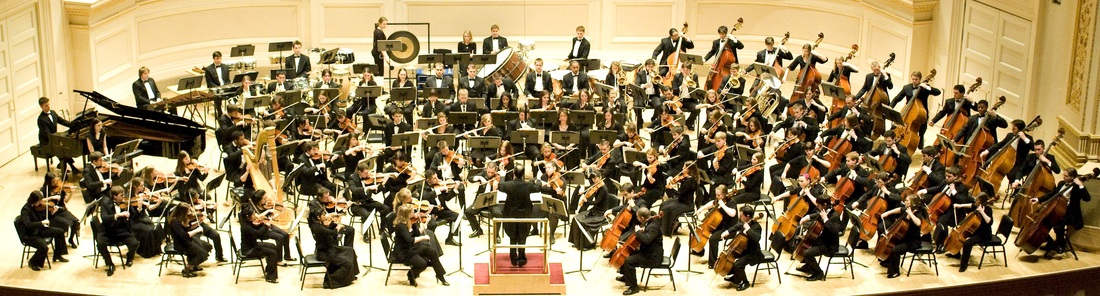
Playing chamber music requires a fundamentally different skillset from playing in an orchestra.

Listen to this recording of a Brahms quartet. The first violin has a long, soaring melody; the cello, a slow descending scale grounding the group. The viola has an undulating line providing rhythm while driving the melody. The second violin has a hybrid role: in the first 3 measures fleshing out the harmony and going up, contrary to the cello. In measures 4 – 6, rhythm is added. Then in 7 – 9, second violin joins the first but in thirds. After that, in 10 – 12, the second gets a mini counter-melody of its own.


Miles Davis’ Kind of Blue is chamber music. However, just because a group is one on a part doesn’t make it chamber music. A lot of rock is a soloist with a supporting band. Your neighbor jamming in his basement with three buddies and a case of cold Gansett – um….maybe?
Ironically, perhaps the greatest examples of chamber music are solo works where the performer is in dialogue with himself. Listen to Alfred Brendel playing Beethoven’s Moonlight sonata. You’ve got your base line (cello), a rolling obligato (viola), a clear melody (violin). No note is just played, everything is shaped, and a beautiful slow dance ensues between the left and right hands.
In the end, perhaps chamber music isn’t a thing so much as a process.
David Yang, Artistic Director

By
David YangA great review of summer 2026 from Classical Voice North America
By
David YangHere is a list of the music that was performed last night at St. Anna's Chapel
NCMF relies on the assistance of corporations, foundations, and most importantly, you.
Make a GiftVolunteerCorporate Sponsors


